
Verification
Qualify the supply route.
Review ENGIC’s current ISO certificates and published standards, or request project-specific documentation and representation confirmation during a qualified enquiry.
Piping Flanges
Flange solutions for pressure, connection, and project-critical piping systems
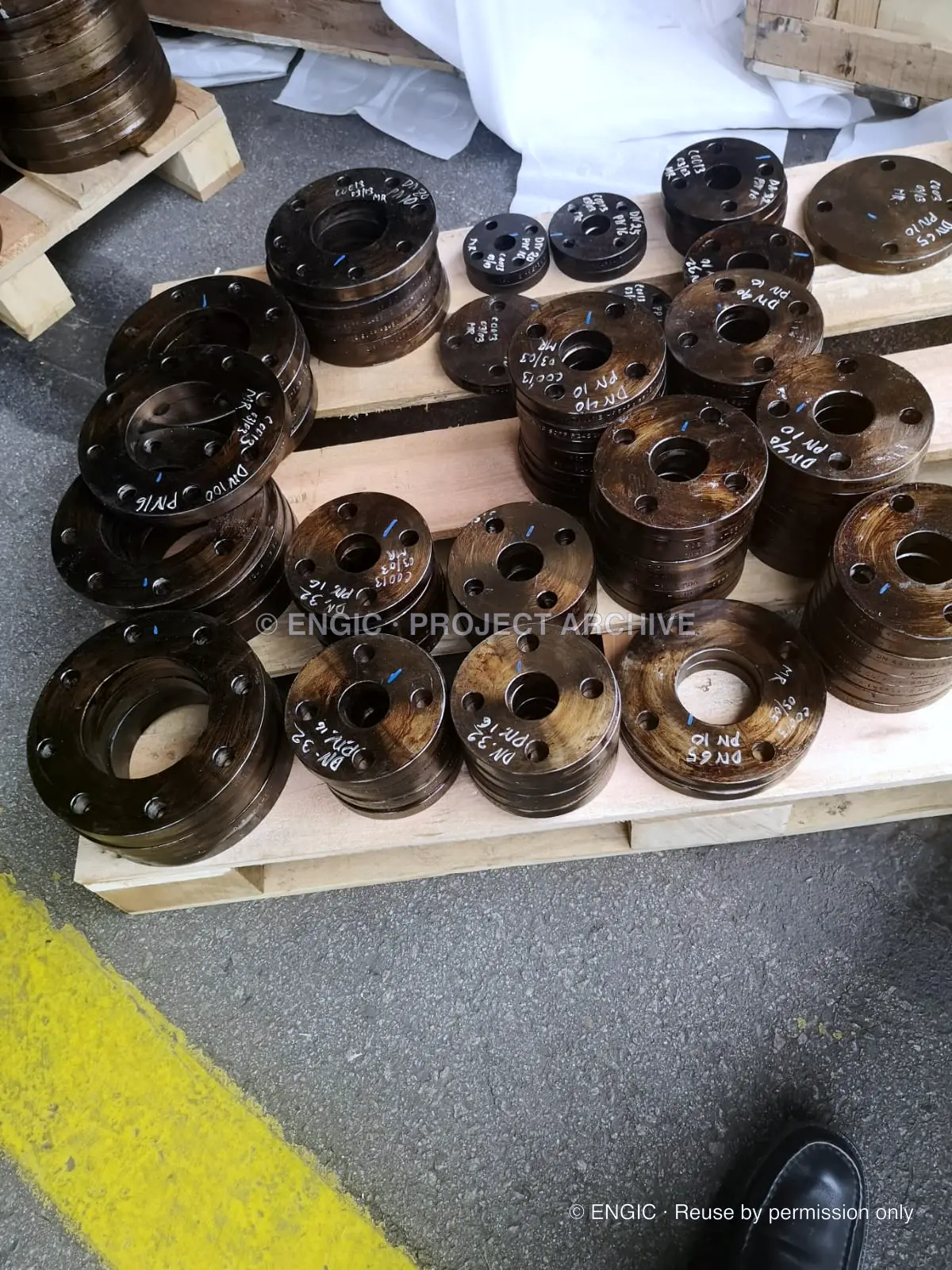
ENGIC supplies piping flanges for oil and gas, energy, process, offshore, utilities, infrastructure, water, marine, petrochemical, and industrial applications.
Our flange range supports standard piping connections as well as high-pressure, large-diameter, high-yield, sour service, low-temperature, corrosion-resistant, compact, anchor, and custom project requirements.
Products are selected according to pressure class, size, face type, material grade, dimensional standard, coating requirement, corrosion environment, inspection scope, certification requirement, and project specification.
ENGIC supports clients with flange selection, material alignment, specification review, manufacturer coordination, inspection documentation, certification control, and delivery follow-up.
Flange types may include:
Common pressure ratings may include:
Common face types may include:
Common material options may include:
Standards and compliance may include:
The envelope ENGIC has supplied against:
WN
Weld neck
Tapered hub carries bending back into the pipe and the bore matches pipe ID, so there is no discontinuity at the joint. Cyclic, severe and high-pressure duty, Class 600 upward.
SO
Slip-on
Bore is larger than pipe OD; the pipe slides in and is held by a fillet weld inside and out. General service, limited to Class 600.
SW
Socket weld
Pipe lands on a machined counterbore shoulder, deliberately set back so the weld is not loaded by thermal expansion. Small bore, 4 in and under, high pressure.
LJ
Lap joint
Backing flange is loose and turns freely on a stub end, so bolt holes need no clocking and the flange never contacts the medium. Chosen where a joint is broken often.
THRD
Threaded
NPT to ASME B1.20.1, no welding at all. Low-pressure utility duty, and areas where hot work is not permitted.
BL
Blind
No bore. Closes off a line, a flanged fitting or a valve, and is the flange used to pressure-test a system before tie-in.
FF
Flat face
Full-face gasket. Classes 150 and 300, and the joint used to meet 125 lb and 250 lb cast iron without cracking it.
RF
Raised face
The default facing. 1.6 mm rise through Class 300, 6.4 mm above it; serrated concentric finish 125–250 AARH.
RTJ
Ring-type joint
Metal ring deforms into machined grooves; faces stand off. Specified from Class 600 upward. Groove side wall ≤ 1.6 µm Ra.
T&G
Tongue and groove
Gasket fully confined radially, so it cannot blow out. High-pressure and critical duty.
M&F
Male and female
Female recess retains the gasket on its outside diameter. Common on exchanger and vessel covers.
ASME B31.3 does not permit facings of different type to be bolted together. Confirming the facing on both sides of a joint is part of what Engic checks before a purchase order is released.
Review ENGIC’s current ISO certificates and published standards, or request project-specific documentation and representation confirmation during a qualified enquiry.
ENGIC supplies engineered valves for isolation, control, safety, pressure, shutdown, throttling, and demanding flow applications across energy, offshore, process, utility, infrastructure, marine, and industrial projects.
02ENGIC supplies actuator and valve automation packages for manual, on-off, modulating, fail-safe, throttling, direct gas, high-pressure, and emergency shutdown applications.
03ENGIC supplies standard, special, forged, heavy-wall, high-yield, alloy, and custom pipe fittings for engineered piping systems across energy, offshore, utility, infrastructure, marine, and industrial projects.