Skip to content
ENGIC
Standards

Global Standards. Project-Specific Execution.

ENGIC supports engineered product supply across API, ASME, ASTM, ANSI, MSS, AWWA, EN, DIN, BS, ISO, IEC, NORSOK, DNV, JIS, GOST, KS, GB, NACE / ISO 15156, and client-specific project standards.

From valves, flanges, fittings, tubulars, structural steel, and conduits to project-critical industrial materials, we help clients align products with the correct specification, service condition, inspection requirement, documentation package, and delivery schedule.

Why standards matter

International Standards & Technical Compliance

Engineered supply aligned with global project requirements

ENGIC supports engineered product supply across a broad range of international, regional, industry-specific, and client-specific standards.

Our work is not limited to one geography, one code system, or one procurement convention. We support projects operating under American, European, British, Japanese, Russian/CIS, Korean, Chinese, offshore, marine, oil and gas, water, infrastructure, utility, industrial, and project-specific requirements.

For EPCM, energy, infrastructure, and industrial clients, standards alignment is not a formality. It affects material selection, pressure ratings, dimensional compatibility, corrosion resistance, inspection scope, certification, documentation, installation, safety, and long-term asset integrity.

ENGIC helps clients source and coordinate products according to the applicable project specification, service conditions, inspection requirements, regulatory expectations, and delivery schedule.

Standards we support

Recognised international and regional standards.

ENGIC can support product supply, technical clarification, and documentation alignment across the following standard families.

01

Oil, Gas, Pipeline & Energy Standards

API has developed more than 800 standards supporting safety, environmental protection, sustainability, and global recognition across the oil and gas industry. That makes API a critical standards family for ENGIC's valve, tubular, pipeline, and energy-sector supply work.

  • API

    American Petroleum Institute

  • API 5L

    Line pipe

  • API 5CT

    Casing and tubing

  • API 5DP

    Drill pipe

  • API 6A

    Wellhead and Christmas tree equipment

  • API 6D

    Pipeline valves

  • API 600

    Steel gate valves

  • API 602

    Compact forged steel gate valves

  • API 607

    Fire testing for quarter-turn valves and non-metallic seats

  • API 608

    Metal ball valves

  • API 609

    Butterfly valves

  • API 594

    Check valves

  • API 598

    Valve inspection and testing

  • API 1104

    Welding of pipelines and related facilities

02

Piping, Pressure, Flanges & Mechanical Standards

ASME B16.5, for example, covers pressure-temperature ratings, materials, dimensions, tolerances, marking, testing, and designation methods for pipe flanges and flanged fittings from NPS 1/2 through NPS 24.

  • ASME

    American Society of Mechanical Engineers

  • ANSI

    American National Standards Institute

  • ASME B16.5

    Pipe flanges and flanged fittings

  • ASME B16.9

    Factory-made wrought butt-welding fittings

  • ASME B16.10

    Face-to-face and end-to-end valve dimensions

  • ASME B16.11

    Forged fittings, socket-welding and threaded

  • ASME B16.20

    Metallic gaskets for pipe flanges

  • ASME B16.25

    Butt-welding ends

  • ASME B16.34

    Valves: flanged, threaded, and welding end

  • ASME B16.47

    Large-diameter steel flanges

  • ASME B31.1

    Power piping

  • ASME B31.3

    Process piping

  • ASME B31.4

    Pipeline transportation systems for liquids and slurries

  • ASME B31.8

    Gas transmission and distribution piping systems

  • ASME BPVC

    Boiler and Pressure Vessel Code

03

Materials, Testing & Quality Standards

  • ASTM

    Material specifications and testing standards

  • A105

    Carbon steel forgings for piping applications

  • A106

    Seamless carbon steel pipe for high-temperature service

  • A182

    Forged or rolled alloy and stainless steel pipe flanges, fittings, valves, and parts

  • A234

    Piping fittings of wrought carbon steel and alloy steel

  • A312

    Seamless, welded, and heavily cold worked austenitic stainless steel pipe

  • A333

    Seamless and welded steel pipe for low-temperature service

  • A350

    Carbon and low-alloy steel forgings for low-temperature service

  • A403

    Wrought austenitic stainless steel piping fittings

  • A420

    Piping fittings of wrought carbon steel and alloy steel for low-temperature service

  • A694

    Carbon and alloy steel forgings for pipe flanges, fittings, valves, and parts for high-pressure transmission service

  • A860

    Wrought high-strength low-alloy steel butt-welding fittings

04

Valve, Fitting & Manufacturer Standardisation

  • MSS

    Manufacturers Standardization Society

  • MSS SP-25

    Standard marking system for valves, fittings, flanges, and unions

  • MSS SP-44

    Steel pipeline flanges

  • MSS SP-55

    Quality standard for steel castings

  • MSS SP-75

    High-test wrought butt-welding fittings

  • MSS SP-83

    Class 3000 steel pipe unions, socket-welding and threaded

  • MSS SP-95

    Swage nipples and bull plugs

  • MSS SP-97

    Integrally reinforced forged branch outlet fittings

  • MSS SP-110

    Ball valves, threaded, socket-welding, solder joint, grooved, and flared ends

05

European, British & International Standards

  • EN

    European Standards

  • DIN

    German standards

  • BS

    British Standards

  • ISO

    International Organization for Standardization

  • PED

    Pressure Equipment Directive

  • EN 1092-1

    Flanges and their joints

  • EN 10204

    Metallic product inspection documents

  • EN 10210

    Hot-finished structural hollow sections

  • EN 10219

    Cold-formed welded structural hollow sections

  • EN 10253

    Butt-welding pipe fittings

  • EN 10255

    Non-alloy steel tubes suitable for welding and threading

  • EN 10297

    Seamless circular steel tubes for mechanical and general engineering purposes

  • EN 10305

    Steel tubes for precision applications

  • ISO 3183

    Petroleum and natural gas industries: steel pipe for pipeline transportation systems

  • ISO 5208

    Industrial valves: pressure testing of metallic valves

  • ISO 5211

    Industrial valves: part-turn actuator attachments

  • ISO 5752

    Metal valves for use in flanged pipe systems: face-to-face and centre-to-face dimensions

  • ISO 7005

    Pipe flanges

  • ISO 9001

    Quality management systems

  • ISO 14001

    Environmental management systems

  • ISO 45001

    Occupational health and safety management systems

06

Sour Service, Corrosion & Material Selection

NACE MR0175 / ISO 15156 is used for materials selection in oil and gas production environments where sulfide stress cracking and H₂S-related cracking mechanisms must be considered. TWI notes that ISO 15156 is the relevant standard family for exploration and production sour service, while NACE MR0103 is used for refinery applications.

  • NACE MR0175 / ISO 15156

    Materials for use in H₂S-containing environments in oil and gas production

  • NACE MR0103

    Materials resistant to sulfide stress cracking in corrosive petroleum refining environments

  • AMPP standards

    Corrosion control, coatings, materials performance, and asset integrity

  • ISO 21457

    Materials selection and corrosion control for oil and gas production systems

  • ISO 12944

    Corrosion protection of steel structures by protective paint systems

07

Offshore, Marine & Energy Project Standards

NORSOK standards are developed by the Norwegian petroleum industry to support safety, value creation, and cost effectiveness for petroleum developments and operations. They are also intended, where possible, to replace individual oil-company specifications and serve as references in authority regulations.

  • NORSOK

    Norwegian petroleum industry standards

  • DNV

    Marine, offshore, and energy standards

  • ABS

    American Bureau of Shipping

  • Lloyd's Register

    Marine and offshore classification

  • BV

    Bureau Veritas

  • RINA

    Marine and offshore classification

  • IEC

    Electrical and instrumentation standards

  • IEEE

    Electrical, electronic, and power systems standards

08

Japanese, Korean, Chinese & Russian/CIS Standards

  • JIS

    Japanese Industrial Standards

  • JPI

    Japan Petroleum Institute standards

  • KS

    Korean Standards

  • GB

    Chinese national standards

  • HG / SH / JB

    Chinese chemical, petrochemical, and machinery standards

  • GOST

    Russian/CIS standards

  • TR CU / EAC

    Eurasian conformity and customs union requirements

09

Water, Utility & Infrastructure Standards

  • AWWA

    American Water Works Association

  • BS EN utility standards

  • ISO water and infrastructure standards

  • Ductile iron pipe and fitting standards

  • Coating, lining, and pressure-pipe standards

  • Municipal and authority-specific specifications

10

Electrical & Conduit Standards

  • UL 6

    Rigid metal conduit

  • UL 797

    Electrical metallic tubing

  • UL 1242

    Intermediate metal conduit

  • ANSI C80.1

    Rigid steel conduit

  • ANSI C80.3

    Electrical metallic tubing

  • ANSI C80.6

    Intermediate metal conduit

  • IEC standards

    Electrical and instrumentation systems

  • Project-specific electrical installation standards

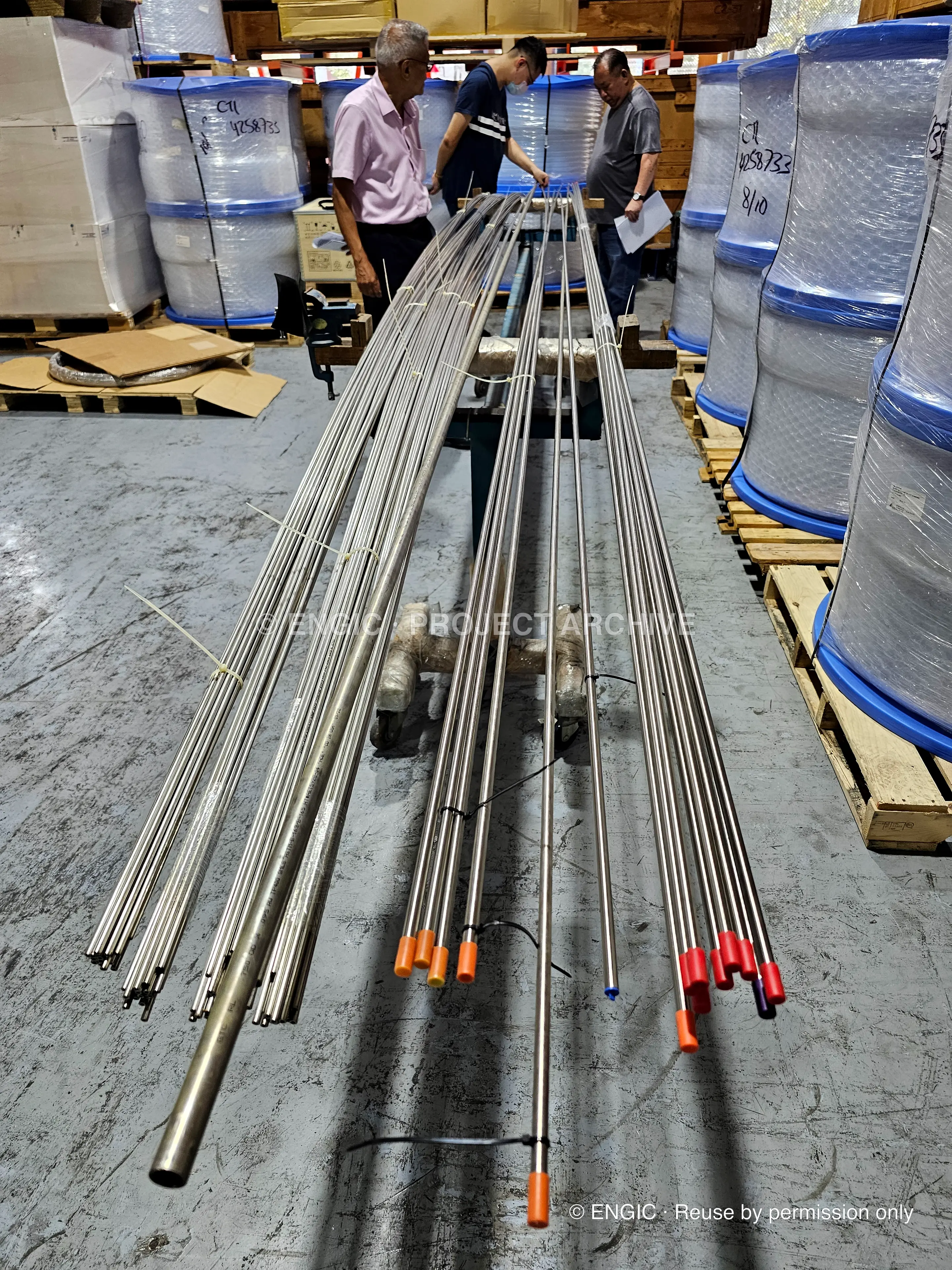
Bright stainless bar and tube stock. Material grade, not appearance, is what a standard governs.
What standards alignment means in practice

Standards compliance is not just an acronym beside a product description.

For ENGIC, standards alignment may involve:

  • →Reviewing the applicable project specification
  • →Matching the product category to the correct standard family
  • →Confirming material grade and pressure class
  • →Checking dimensional compatibility
  • →Reviewing temperature and service conditions
  • →Considering sour service, corrosion, or low-temperature requirements
  • →Confirming end connections, face types, coatings, linings, and finishes
  • →Coordinating required inspection and testing
  • →Managing certification and documentation requirements
  • →Supporting manufacturer clarification where required
  • →Coordinating delivery according to project schedule
Product categories covered

ENGIC applies multi-standard sourcing and documentation support across:

  • Engineered valves
  • Valve actuators
  • Pipe fittings
  • Piping flanges
  • OCTG
  • Energy tubulars
  • Standard tubulars
  • Structural steel
  • Electrical conduits
  • Project-critical industrial materials
  • Custom and special supply packages
Documentation & certification support

Depending on the product, project, and applicable standard, ENGIC can support documentation requirements such as:

  • →Material Test Certificates
  • →EN 10204 3.1 / 3.2 inspection certificates
  • →Certificates of Conformity
  • →Manufacturer data books
  • →Inspection and test plans
  • →Welding documentation
  • →NDE / NDT reports
  • →Hydrotest reports
  • →Pressure test certificates
  • →PMI reports
  • →Coating and lining reports
  • →Dimensional inspection reports
  • →Heat treatment records
  • →Traceability documents
  • →Packing lists and shipping documents
  • →Project-specific vendor documentation
Inspection & testing support

ENGIC can coordinate inspection and testing requirements according to project needs, including:

  • →Visual inspection
  • →Dimensional inspection
  • →Hydrostatic testing
  • →Pneumatic testing where applicable
  • →Non-destructive examination
  • →Positive Material Identification
  • →Hardness testing
  • →Impact testing
  • →Coating inspection
  • →Witness inspection
  • →Third-party inspection coordination
  • →Final documentation review
Multi-standard supply philosophy

One project. Multiple standards. One accountable supply partner.

Modern projects rarely operate under a single standard. A single engineered supply package may include API valves, ASME flanges, ASTM materials, EN documentation, NACE sour service requirements, NORSOK offshore requirements, IEC electrical requirements, and client-specific project specifications.

ENGIC helps clients manage that complexity.

Our role is to support technically aligned sourcing, supplier coordination, documentation control, inspection readiness, and delivery follow-up across multiple standards and product categories.

We do not treat standards as marketing labels. We treat them as project requirements that must be understood, coordinated, documented, and delivered correctly.

Standards disclaimer

Product availability, sizes, pressure classes, materials, coatings, linings, testing, certifications, documentation, country approvals, and delivery schedules are subject to the applicable project specification, manufacturer capability, regulatory requirements, inspection scope, and commercial confirmation.

ENGIC does not claim automatic compliance for every product in every jurisdiction. Compliance must be confirmed against the specific project specification, product type, manufacturer, certification package, and end-use application.

Need supply aligned to a specific standard?

Share your project specification, material requirement, pressure class, service condition, inspection scope, and delivery requirement.

ENGIC can support technical clarification, sourcing coordination, documentation control, and project-aligned supply.